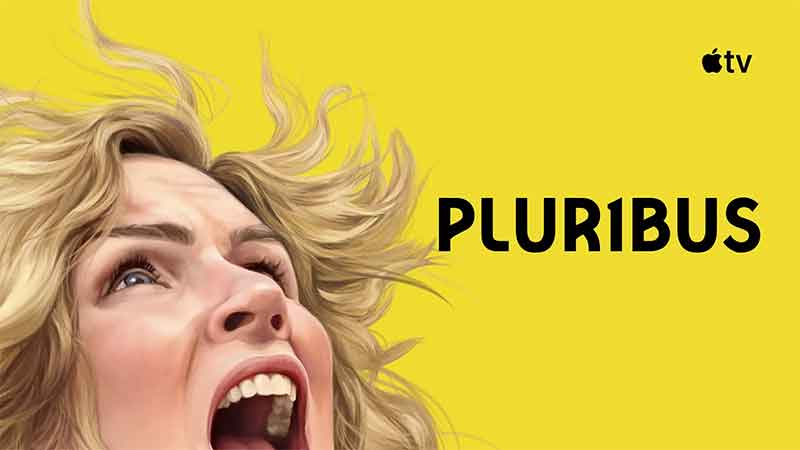
I am a fan of Better Call Saul and Breaking Bad so when I learned producer Vince Gilligan had a new hit show called Pluribus on Apple TV, I had to check it out. The program addresses an urgent yet rarely-addressed issue: cruelty to animals and the destruction of the planet. The plot is as follows: A virus transforms everyone in the world—except Carol (the lead character) and few other humans—into loving, gentle, and cooperative beings. They treasure all life forms and do not intentionally harm animals or plants. They open the gates at farms and zoos, so all living beings can be free.
I viewed the transformed collective (aka “the Joined” or “the Hive”) as the hero of the show. Who wouldn’t? I quickly learned that I was in the minority! I inspected online forums and learned a battle rages between “Team Carol” and “Team Hive.” Those who align themselves with Carol argue that the Hive is evil because it steals freedom of the will (despite the fact that science provides no evidence for free will). Members of Team Carol lash out at their opponents, calling them immoral, idiots, and traitors to the human race—adding that it is wrong to equate the life of a person with the life of an animal. Others say the Hive kidnaps souls, turns people into slaves, and is causing the human species to go extinct. A few assert that a nuclear Armageddon is preferable to the end of Homo sapiens.
Team Hive folks have their arguments as well. They say the Hive is an improvement over Homo sapiens’ selfish, shallow, and money-oriented ways; a “joined” world benefits the poor in third-world nations, starving children, victims of violence, and the physically and emotionally challenged while only really hurting affluent Westerners and megalomaniac billionaires (who lose their property and VIP status). Other Hivers argue that the “Carol crowd” is under an illusion of human superiority and are, in fact, hive-minded themselves because they follow the values of Western culture like robots while lacking compassion for the animals kept as slaves in vivisection labs and on factory farms. Hivers explain that people trash the environment, torture and mutilate nonhumans, fill oceans with plastic, decimate forests, pollute, overconsume, destroy habitats, and build nuclear weaponry.
One could argue that the conflict between Team Carol and Team Hive revolves around a West versus East mindset. Western culture and the Judeo-Christian religion tend to promote competition, self-sufficiency, consumerism, individualism, capitalism, and “man as the crown of creation” while the Eastern traditions focus on cooperation, harmony, and community. Many Eastern cultures recognize that there is no free will, absolute morality, or single soul destined for a heaven or hell.
This brings me to Jainism, because its core principles mirror that which is embraced by the Pluribus Hive. This Eastern religion has approximately ten million followers and dates back to India in the sixth century BCE. It is centered around ahimsa or nonviolence to all living beings. Adherents are vegetarian or vegan, take spiders outside rather than kill them, believe in harmony with all species, and have a love for the environment.
Jains view angry words to be violent as does the Hive—a concept emphasized in Pluribus when Carol’s rage-filled outbursts kill millions of Joined people while causing convulsions in others. Jain ascetics (i.e. monks) are similar to the Hive: Neither will pluck an apple from a tree. Although the Hive is more lenient than orthodox Jains in some respects (by driving cars, drinking alcohol, flying planes, and eating creatures who die naturally), they are more stringent than Jain laypeople who will pick fruit. Ordinary Jains might say that this action is harmless, because the plant remains intact.
Admirable standards can be arduous, even impractical. According to the show, the Hive’s stringent rules around sustenance mean their lifespan will be restricted to ten years due to a limited food supply. That is, unless a remedy can be found. This is when some of the remaining humans (apart from Carol) seek a solution to the problem. But what if a solution cannot be found? What if there are only two options: reinstate the pre-virus society or let Homo sapiens become extinct in a decade?
I argue the latter is preferable. Humans are a tiny species among millions. People kill over 100 billion land animals in factory farms each year—a number that does not include fish or birds… or animals used for other purposes. In addition, human activities destroy the planet; people have decimated one-third of the forests on Earth.
Carol and Manousos (another Pluribus character) say they want to “save the world.” But this is a lie. They cannot see outside the “human bubble.” They only want to save one miniscule and elite species: their own. They think the world is of, by, and for people. To them, nothing else matters.
Saving the planet actually means having compassion for all living beings. Saving the planet means respecting the environment. And in Pluribus, saving the planet means the Hive wins.
____
By Charlotte Laws. Published in Countercurrents Magazine on January 7, 2026. [Charlotte Laws, Ph.D. is the author of two 2025 books. Elevator People: A Time Travel Novel (which has a Pluribus-like storyline). And Omniocracy: A Government that Represents All Living Beings (which has a chapter on Jainism, aka the Hive mindset)].